
Prime Minister Narendra Modi on Tuesday said resumption of talks with Pakistan was to "try and turn the course of history" and to bring an end to terrorism, but made it clear that the neighbouring country would be judged by its commitment on terrorism.

Had India agreed to join the trade pact, Indian markets would have been flooded with cheap Chinese products.
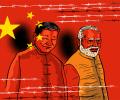
'An opportunity is at hand to think big and recast the India-China relationship on a new template, which would help the pursuit of our country's dream of major power status,' says Ambassador M K Bhadrakumar.

Prime Minister Narendra Modi's visit to South Korea is considered essential in strengthening defence ties, enhancing economic cooperation and forging cultural ties between the two countries, says Dr Rahul Mishra

Hamid Ansari on Friday left for Lima on the first-ever visit at the Vice Presidential level to mineral-rich Peru and Communist Cuba as part of India's thrust towards Latin America.
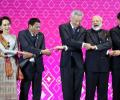
The prime minister also welcomed convergence of views between India and ASEAN for cooperation in the Indo-Pacific region.

Describing the just concluded United States visit of Prime Minister Narendra Modi as extraordinarily successful, the White House has said that his meeting with President Barack Obama has re-energised the strategic relationship between the two largest democracies of the world.
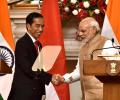
The two countries, among the very few fast growing large economies globally, also decided to boost bilateral trade and investment in areas of oil and gas, renewable energy, IT and pharmaceuticals, during talks between Prime Minister Narendra Modi and Indonesian President Joko Widodo.

Moving ahead with their new mantra -- Chalein Saath Saath: Forward Together We Go -- Prime Minister Narendra Modi and United States President Barack Obama on Tuesday vowed to deepen cooperation in every sector for the benefit of global stability and people's livelihoods over the next ten years.
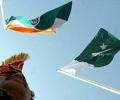
Emphasising that the LoC ceasefire should be maintained, Pakistan's highest body on security issues led by Prime Minister Nawaz Sharif today said the country will continue to seek peaceful settlement of all outstanding issues with India.

Sushma Swaraj's suave moves helped Narendra Modi pull off a diplomatic coup, helping regain her standing.

India said a new mechanism will be set up for issues relating to trade and investment.

Seeking to allay India's concerns, ambassador Luo had offered to rename the CPEC which passes through Pakistan-occupied Kashmir, insisting it was an economic cooperation and connectivity enhancement project devoid of "sovereignty issues".

'If the situation escalates, then mini-scale firing might happen.'

India and China ties are likely to enter into a "new age of cooperation" especially in trade in view of Prime Minister Narendra Modi's knowledge of Chinese investment promotion and his plans for economic reforms, according to an official think-tank in Beijing.
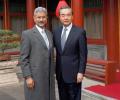
India on Wednesday hit out at China for demanding "solid evidence" for getting Jaish-e-Mohammed chief Masood Azhar banned by the United Nations

Prime Minister Narendra Modi's focus on development and inclusive growth was widely appreciated by the audience at the UN.

Afghanistan said Pak was diverting attention of the international community from its 'longstanding failure' to take effective action against terrorist groups.

PM indirectly referred to North Korea's proliferation linkages with Pakistan.
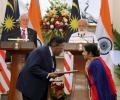
Considering the common linkages, high-level trust, complementarities, and convergent interests between the two nations, Malaysia has the potential to become India's key partner in Southeast Asia, says Dr Rahul Mishra.
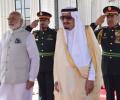
India's ties with Saudi Arabia have been on an upswing over the last two decades based on burgeoning energy ties. Both sides are keen on expanding the economic ties in a range of areas besides the oil sector.

Modi said India will continue its support to ASEAN for a rules-based security architecture for the region.
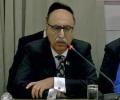
Striking a conciliatory note amid rising tension in ties, Pakistan today said it does not want to live in "perpetual hostility" with India, noting time has come for the two neighbours to decide whether status quo should continue or a new beginning be made.

"We often thought of terrorism as a peripheral problem for this region. The barbaric terrorist strikes in Paris, Ankara, Beirut, Mali and on the Russian aircraft is a stark reminder that its shadow stretches across our societies and our world, both in recruitment and choice of targets," Modi said in his remarks at the East Asia Summit.

The declaration also names Pak-based terror groups like LeT and JeM.
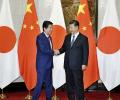
'Both Japan and China face a common challenge: How to deal with Trump.' 'The trade war with the US seems to have facilitated/hastened Abe's China visit, the first by a Japanese prime minister since 2011,' points out Dr Rajaram Panda.

External Affairs Minister Sushma Swaraj, who held extensive talks with Egyptian leadership on Monday, proposed to step up exchange of information and coordination to combat terrorism, both at the regional as well as global level

Amid escalation in violence in a number of Gulf countries, India on Thursday expressed deep concern over the rise of fanaticism, extremism and terrorism in parts of the Arab region, saying they are tearing apart the fabric of societies as well as affecting regional stability.

During their talks, the two leaders decided to significantly expand their ties in several key areas including defence, trade, energy and education.
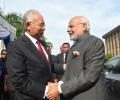
Both countries will advance maritime security and strengthen disaster response in the region, says Modi.

Text of PM Narendra Modi's press statement after delegation level talks with US President Obama at the Hyderabad House in Delhi.

Media reports said North Korea has successfully miniaturised a nuclear warhead that can fit inside its missiles.
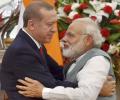
Turkish President Recep Tayyip Erdogan's has been trying to mollycoddle India with sweet nothings while having a very close relationship with Pakistan.

'New Delhi showed itself willing -- at least for a period -- to tolerate the risk of conflict and to withstand Beijing's implicit and explicit threats.' 'But it also continued to try to cut some kind of deal with China to reduce tensions.'

'We should expect a cold-blooded, transactional relation that requires a lot of engagement and mutual trust to sustain,' says Constantino Xavier, Fellow, foreign policy, Brookings India.

Swarup said India looks forward to the prompt and decisive action promised by Pakistan Prime Minister Nawaz Sharif to his counterpart Narendra Modi.

The two countries also asked all nations to stop cross-border movement of terrorists and asserted that a decisive collective response from the international community without 'double standards and selectivity' was required to combat the threat of terrorism.

Talking about the Line of Actual Control, Defence Minister Nirmala Sitharaman said as it is not completely demarcated, there are differing perceptions about it by both sides.

'The public has unfair expectations from Mrs Swaraj who is in Islamabad primarily for the Heart of Asia Conference. To restore India's position among stakeholders on Afghanistan is a fair one but to expect her to do more on the Indo-Pak front without requisite preparatory work is unrealistic.'

Amid souring ties, the president visited Beijing for three days. On his return to India, a hope of better ties has arisen, says senior correspondent R Rajagopalan, who travelled with Pranab Mukherjee to the Asian superpower.
